HomeBusinessHow compounding helps small investments grow into big wealth
How compounding helps small investments grow into big wealth
Let’s start simple. Money grows. But it’s not always loud. Not always fast. Sometimes it grows like grass; you don’t notice it every day, but when you return later, you ask yourself, “Wait, when did this happen?”
The power of compounding subtly enters the room at that point.
It doesn’t yell. It doesn’t guarantee instant wealth. It does nothing but sit there, layering growth on top of growth, much like building a wall out of tiny bricks. To be honest, most people miss it because it’s initially boring rather than because it’s complicated.
And yet, the power of compounding is probably the closest thing to financial magic that actually exists in the real world.
So, What Is This “Compounding” Thing, really?
Alright, imagine this.
You invest a small amount. Let’s say ₹1,000. It earns some returns. Cool. Next year, you don’t just earn returns on your original ₹1,000, you earn returns on the returns too.
Now pause. Think about that.
You’re not just growing your money. Your money is… growing itself.
That’s compounding.
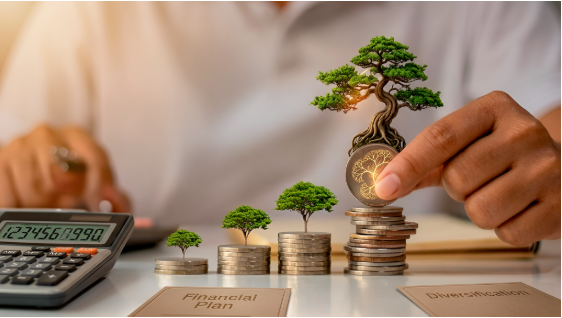
It’s like planting a tree. First year? Tiny sapling. Second year? Still small. But give it time. Real time. And suddenly you’re sitting under the shade, wondering how something so small became so massive.
The Beginning Is Always Underwhelming
Now here’s the honest part. The part nobody likes to hear.
Compounding is painfully slow in the beginning.
You invest. You wait. You check. Nothing exciting.
You might even think, “Is this even working?”
That’s normal. Completely normal.
Because in the early years, growth looks… flat. Almost disappointing. Like watching water boil. You keep staring, expecting bubbles, but nothing happens for a while.
But then, somewhere down the line, it changes. Gradually. Quietly. And then suddenly.
Time: The Real Hero (Not High Returns)
People are obsessed with returns. 10%, 12%, 15%. Higher, higher, higher.
But here’s a slightly uncomfortable truth.
Time matters more.
Yeah, I know. It sounds too simple. But think about it, what’s better?
-
Investing ₹5,000 monthly for 25 years
-
Or ₹10,000 monthly for 10 years
The first one often wins. Why? More time. More cycles. More compounding layers.
It’s like cooking on a low flame. Slow heat. Deep flavour.
Small Investments, Big Surprises
Let’s be real. Not everyone has lakhs to invest.
Most people start small. ₹500. ₹1,000. Maybe ₹2,000 if things are going well.
And that’s perfectly fine.
Because compounding doesn’t care about how big your starting point is. It cares about consistency.
You show up every month? It rewards you.
You skip around, start and stop, and chase trends? It punishes you.
It’s almost like a strict teacher. Fair, but firm.
The Curve That Changes Everything
There’s this moment, hard to predict exactly when and where growth stops being linear and starts bending upward.
That curve? That’s where things get interesting.
At first, your money grows in straight lines. Predictable. Calm. Meh.
Then suddenly… it curves. And not gentle. Sharply.
That’s when people go, “Wait, how did this jump so much?”
But here’s the catch! You only get that curve if you stay long enough.
Leave early, and you miss the best part.
The Trap Most People Fall Into
Let me guess. You’ve seen this before.
-
Start investing
-
Get excited
-
Check returns every week
-
Panic when market drops
-
Stop investing
Yeah. It happens all the time.
The biggest enemy of compounding isn’t the market. It’s impatience.
People want results fast. It’s similar to placing an online food order: tap, wait, and order received.
However, that is not how compounding operates. It resembles farming more. You plant it. You irrigate. You hold off. You have faith.
Intensity is defeated by consistency.
This is an odd notion. You don’t have to periodically make large investments.
You must consistently make modest investments.
Intensity is inferior to consistency.
It is comparable to visiting the gym. Your body won’t change after one hard workout. But it will be if you show up every day, even for just 20 minutes.
The same is true of money.
The Emotional Aspect Nobody Discusses Now, this is intriguing.
Now, here’s something interesting.
Compounding isn’t just financial. It’s emotional.
There will be days when markets fall. Your portfolio is dropping. You feel uneasy. Doubt creeps in.
“Should I stop?”
“Am I doing this wrong?”
That’s where discipline matters.
Because the people who benefit from compounding aren’t the smartest. They’re the most patient.
A Quick Reality Check
Let’s not romanticise it too much.
Compounding is powerful, but only if:
-
You start early.
-
You stay consistent
-
You don’t interrupt it.
Break any one of these, and the effect weakens.
It’s not fragile, but it’s sensitive.
The Late Starter’s Dilemma
Now maybe you’re thinking, “I started late.”
First of all, relax.
Yes, earlier is better. But being late is still better than ever.
You just need to compensate with the following:
-
Slightly higher investments
-
More discipline
-
Clearer goals
You won’t have as much time, but you still have time.
And that matters.
The Snowball Effect (And Why It Feels Unreal)
Ever rolled a snowball downhill?
It starts tiny. Almost nothing. But as it rolls, it picks up more snow. Gets bigger. Faster. Heavier.
That’s compounding.
And here’s the wild part, you don’t push it forever. At some point, it carries itself.
That’s when your money starts working harder than you do.
Interruptions: The Silent Killer
Let’s talk about something people ignore.
Breaks.
Stopping investments. Withdrawing early. Changing plans repeatedly.
Every interruption reset momentum.
It’s like stopping a moving train. Starting again takes effort. Time. Energy.
Compounding hates interruptions.
A Personal Thought (Just Between Us)
If I could go back in time, not change everything, just one thing, I’d start earlier.
Not bigger. Just earlier.
Because once you truly understand how compounding behaves, you realise it’s not about chasing returns, it’s about not disturbing the process.
Where People Go Wrong
Not with money. With a mindset.
They treat investing like a sprint. Quick gains. Fast exits.
But compounding? It’s a marathon. Actually… longer than a marathon. It’s a lifestyle.
You don’t “do” compounding. You live in it.
The Second-Last Thought (Read This Slowly)
Here’s something most people realise too late:
The biggest gains from compounding don’t come in the beginning. Or even in the middle.
They come an end.
That last phase where growth accelerates, multiplies, and almost surprises you that’s where the real magic happens. And if you quit early, you never experience the true [power of compounding].
Final Thoughts Over Coffee
So, what is the takeaway?
Start small. Stay consistent. Be patient.
That’s it. No secret formula. No shortcut.
Because in the end, wealth isn’t built by doing extraordinary things at once. It’s built by doing ordinary things repeatedly and letting time amplify them.
And when you finally look back years later, maybe decades you’ll realise it wasn’t a luck. It wasn’t timing.
It was simply the quiet, steady, almost invisible power of compounding working in your favour all along.